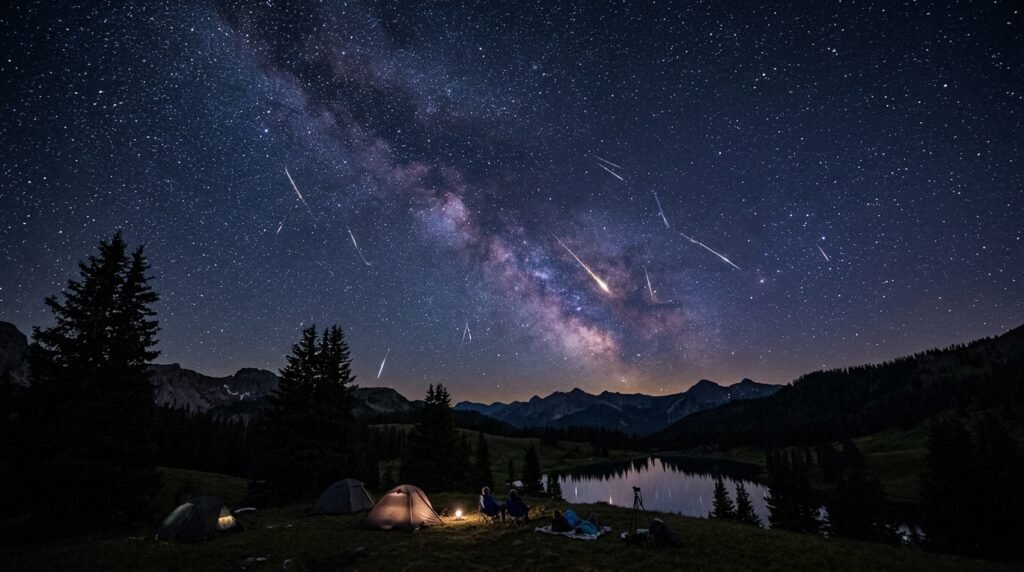

Ask an astronomer what event they recommend to a total beginner, and most will not say a planet or a nebula. They will say a meteor shower. The reason is simple. No telescope, no experience, and no money are required. You lie back, look up, and the sky performs. Yet most people have never properly watched one, usually because they stood outside at the wrong time, in the wrong place, for ten minutes, and saw nothing. This guide fixes that.
What a meteor shower actually is
A meteor shower is not stars falling, and it is not random. Every year, the Earth ploughs through streams of dust and grit left behind by comets (and in one or two cases, by asteroids). These streams are enormous: the parent comet may have passed decades or centuries ago, but its debris lingers in a ribbon along its orbit. When our planet drives through that ribbon, the particles hit the atmosphere at tens of kilometres per second and burn up as streaks of light.
A radiant is the point in the sky from which the meteors appear to fan out, named for the constellation it sits in. The Perseids are named for Perseus, the Geminids for Gemini. The meteors can appear anywhere in the sky, but if you trace their paths backwards, they converge on the radiant. Understanding this matters for planning, because the higher the radiant climbs in your sky, the more meteors you will see.
The big three: Perseids, Geminids, Orionids
The Perseids (peak mid-August) are the classic beginner shower. They run from late July into late August, they are reliable, and their peak arrives on warm summer nights, which removes the suffering from the equation. Rates can reach 60 to 100 meteors per hour under dark skies, and Perseids are famous for bright, long trains that linger after the meteor itself has gone.
The Geminids (peak mid-December) are arguably the finest shower of the year. Their parent is the asteroid 3200 Phaethon, an oddity, and the Geminids produce up to 120 meteors per hour. They are also unusual in that many are bright and richly coloured, greens and golds among the whites. The catch is the cold. December in Britain demands serious clothing and patience, but the payoff is the densest, most consistent display of any shower.
The Orionids (peak late October) are the quiet specialist’s pick. Born of Halley’s Comet, they produce a modest 20 or so meteors per hour at peak, but the meteors are fast, bright, and often leave persistent trains. October evenings are mild enough to be comfortable, and the shower rewards the whole month with activity, so a random clear night can still deliver.
How to watch: no telescope needed
This is the part most guides overcomplicate. Put away any optical aid; binoculars and telescopes narrow your view to a tiny patch and make meteors harder to see. Your naked eyes are the perfect instrument. Check an annual meteor shower calendar to find the peak night and the best hours, which are usually after midnight when the Earth is turning into the stream, like driving into rain on a windscreen.
Face roughly towards the radiant but not directly at it; meteors show longest about 45 degrees away from the radiant, where their paths are more side-on. Give yourself at least 45 minutes, and lie on a reclining chair or blanket so your whole field of view is sky. One useful habit is to pick a meteor shower watching guide for the specific shower you are targeting, since each has quirks: the Perseids’ radiant placement, the Geminids’ slow fat meteors, the Orionids’ speed.
Dark adaptation and comfort tips
Your eyes need 20 to 30 minutes of darkness to reach full sensitivity, and a single glance at a phone screen resets the clock. Dim any screen to its lowest setting, or use a red light, which preserves night vision. White torchlight is the enemy. Wear more clothing than you think you need, even in August; lying still in the open radiates body heat fast. A blanket underneath you matters as much as one on top, because the ground is a heat sink.
Bring a hot drink, and if you go with friends, agree beforehand that the loudest noise will be an occasional delighted gasp. This sounds precious, but a relaxed group that keeps its lights off and its voices low genuinely sees more meteors than a noisy one, because eyes stay adapted and attention stays on the sky.
Planning your shower calendar for the year
A little planning turns meteor watching from a lucky accident into a reliable hobby. Mark the peak nights of the big three on your calendar, then add the minor showers you fancy as bonuses: the Quadrantids in January are sharp and intense but with a narrow peak, and the Lyrids in April are modest but beautifully bright. Check moonlight for each date, because a bright Moon near full can wash out all but the brightest meteors; some years a shower’s peak coincides with darkness and those years are the ones to travel for.
Then simply plan your shower nights a week ahead, watching the weather and the moon phase, and keep a simple log of what you saw. Counts, directions, colours, trains. Over a year you will build a personal record of the sky’s recurring rhythms, which is one of the most satisfying habits in observational astronomy resources of any kind. The sky keeps a schedule. Once you know it, you never have to wonder when the next show is.
