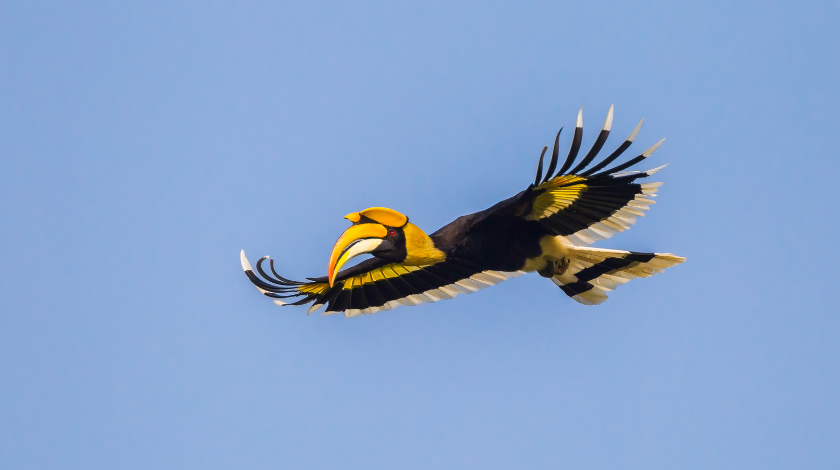
I still remember the first time I saw a Great Hornbill in real life. It was not in a cage but gliding through the canopy of a dense rainforest in Southeast Asia. The sound was the first thing that hit me. It was not a tweet or a chirp. It was a loud, rhythmic whooshing sound, almost like a steam engine passing overhead. When I looked up, I saw this massive creature with a beak that looked too heavy for its body to carry. That moment stuck with me forever. It made me realize that nature has a sense of humor and a sense of grandeur all rolled into one. If you have stumbled upon this topic via glaadblog org or just out of pure curiosity, you are in for a treat because the Hornbill is arguably one of the most interesting birds on our planet.
When we talk about Hornbills, we are not just talking about a bird with a big nose. We are talking about a creature that plays a massive role in keeping our rainforests alive. There are over fifty different species of Hornbills spread across Africa and Asia. They range from the small, insect-eating Tokus of the African savannah to the massive, fruit-eating giants of the Asian rainforests. But despite their differences in size, they all share that signature look which is a long, down-curved bill. To the untrained eye, they might look a bit like Toucans, which are found in the Americas. However, I can tell you that they are not related at all. Toucans and Hornbills are a classic example of convergent evolution, where two different animals evolve similar traits because they live in similar environments.
The Mystery of the Casque: Why Do They Look Like That?
One of the first questions people ask me when looking at a Hornbill is about the thing on top of its head. That structure is called a casque. It looks like a helmet or a second beak growing on top of the first one. For years, scientists and bird lovers have debated the purpose of this casque. Is it a weapon? Is it for show? Or is it something else entirely?
From what we understand now, the casque is hollow in most species. It is made of keratin, which is the exact same protein that makes up your fingernails and hair. Because it is hollow, it acts as a resonating chamber. Imagine yelling into a majestic, empty hall. Your voice gets louder and deeper. That is essentially what the casque does for the Hornbill call. It helps amplify their calls so they can be heard across miles of dense forest. In a noisy rainforest filled with insects and monkeys, you need a loudspeaker to talk to your neighbors, and evolution gave the Hornbill exactly that. However, there is an exception to this rule. The Helmeted Hornbill has a solid casque. This skull is incredibly heavy and is unfortunately used for head-busting aerial fights between males. Sadly, this solid casque is also why they are poached, but we will get into that sad reality a bit later.
Love Under Lockdown: The Incredible Nesting Habits of Hornbills
If I had to pick one thing that makes the Hornbill distinct from every other bird in the sky, it would be their nesting habits. It is a story of trust, sacrifice, and a little bit of claustrophobia. Most birds build a nest of twigs on a branch. The Hornbill does things very differently. When a pair of Hornbills decides to mate, they find a natural hollow in a large, old tree.
Once they find a suitable home, the female enters the hollow tree. Then, something incredible happens. The pair begins to seal the entrance. Using mud, fruit pulp, and droppings, they wall up the opening until there is only a tiny, vertical slit left. This slit is just wide enough for the male to pass food through. The female is now literally trapped inside the tree. She stays there for months. During this time, she lays her eggs and incubates them. She also undergoes a full molt, shedding all her flight feathers, meaning she physically cannot fly even if she broke out.
This puts an immense amount of pressure on the male. He becomes the sole provider for the family. He has to fly back and forth all day, bringing fruits, insects, and small animals to feed his wife and eventually the chicks through that tiny slit. If the male dies or gets injured, the female and the chicks will likely starve to death inside that tree. This level of partnership and dependency is rare in the animal kingdom. It is a high-stakes gamble for survival, but it works because it keeps predators like snakes and monkeys away from the vulnerable eggs.
Famous Species You Should Know
While there are many types, a few stand out as icons of the bird world.
The Great Hornbill is perhaps the most famous. It is massive, with a wingspan that can reach five feet. It has a bright yellow and black casque and body. The yellow color actually comes from preen oil that the bird rubs onto its beak and white feathers, almost like applying makeup. They are culturally significant in places like India and Thailand.
Then there is the Rhinoceros Hornbill. As the name suggests, its casque looks like a rhino horn curving upward. The contrast of the orange-red horn against its black feathers is stunning. These are the birds often associated with the spirits of the forest in local folklore.
We also have to mention the Helmeted Hornbill. This is the heavy-hitter of the group. It looks prehistoric, with a red, bare neck and a weird, maniacal laugh that echoes through the jungle. It is critically endangered, and spotting one is considered a major event for any birdwatcher.
Diet and Ecosystem: Why They Are Called “Farmers of the Forest”
I love the nickname “Farmers of the Forest” because it perfectly describes what Hornbills do. They are omnivores, but many large Asian species eat a lot of fruit, especially figs. Figs are full of tiny seeds. When a Hornbill eats a fig, it flies away, sometimes covering huge distances. Eventually, nature calls, and the bird excretes the seeds.
Because they travel so far, they spread these seeds to new parts of the forest where the parent tree is not competing for sunlight. This helps the forest regenerate and expand. Without Hornbills, many species of hardwood trees would have no way to spread their seeds. The health of the rainforest is directly tied to the health of the Hornbill population. If the birds vanish, the trees stop spreading, and the forest slowly begins to die. It shows just how interconnected everything is. When we protect the Hornbill, we are actually protecting the air we breathe by keeping the forests alive.
Hornbills in Culture and Mythology
I think it is important to touch upon how humans view these birds. In Borneo, specifically among the Dayak people, the Hornbill is a sacred spirit. It is seen as a messenger between the human world and the spirit world. Hornbill feathers were traditionally used in ceremonial headdresses, representing bravery and leadership.
The bird represents fidelity and loyalty because of their monogamous nature. They usually pair for life. If you see a stylized bird motif in Malaysian or Indonesian art, there is a very good chance it is a Hornbill. It is not just an animal to these cultures; it is a symbol of the purity of the natural world.
Conservation Challenges: Are We Losing Them?
This is the part of the article that is difficult to write, but it is necessary. Hornbills are in trouble. The biggest threat they face is habitat loss. Remember how I mentioned they need large, old trees with hollows to nest in? Those are exactly the kinds of trees that logging companies target for timber. When old-growth forests are cut down to make way for palm oil plantations, the Hornbills lose their homes. They cannot just build a nest on a palm oil tree; the structure is all wrong.
Another major threat is poaching. I mentioned the Helmeted Hornbill earlier. Its solid casque is softer than ivory and easier to carve. It is known as “Red Ivory” in the black market. People kill these majestic birds just to carve beads and statues from their skulls. It is a devastating trade that has pushed the species to the brink of extinction.
However, it is not all bad news. Conservation groups are working hard. They are installing artificial nest boxes on trees to give the birds a place to breed in areas where large trees have been cut. There are also stricter laws being enforced to stop the trade of Red Ivory. Ecotourism is helping too. When local communities realize that tourists will pay good money to see a live Hornbill, they have a financial incentive to protect the birds rather than hunt them.
Conclusion
The Hornbill is more than just a bird with a funny beak. It is a devoted parent, a loud neighbor, a cultural icon, and a diligent farmer that keeps our rainforests lush and healthy. Whether you are researching them for a project or just reading this because you love nature, I hope you can appreciate how complex their lives are. The story of the mother bird walling herself in for love is one of the most powerful narratives in nature. We have a responsibility to ensure that the “whoosh” of their wings continues to be heard in the forests of Asia and Africa. If we lose the Hornbill, we lose a piece of the soul of the forest.
Frequently Asked Questions (FAQs)
1. What do Hornbills eat?
Hornbills are omnivores. Their diet changes depending on their species and location. The large Asian hornbills mostly eat fruits, especially figs, which makes them great seed dispersers. However, they also eat insects, small reptiles, mammals, and other birds, especially during the breeding season when they need extra protein for their chicks.
2. Are Hornbills and Toucans related?
No, they are not related. This is a common misconception because they both have large, colorful beaks. Toucans are found in Central and South America, while Hornbills are found in Africa and Asia. Their similarities are due to convergent evolution, where nature solves the same problem in the same way for different animals.
3. Why is the Hornbill called a “Farmer of the Forest”?
They get this nickname because they play a crucial role in spreading seeds. When they eat fruit and fly to different areas, they poop out the seeds. This plants new trees far away from the parent tree, helping the forest grow and regenerate.
4. Can Hornbills fly?
Yes, Hornbills are strong flyers, although they have a unique flying style. They flap their wings heavily and then glide. Because they lack the underwing coverts (small feathers that smooth airflow) that other birds have, their flight is very noisy and creates a loud “whooshing” sound.
5. Are Hornbills dangerous to humans?
Generally, no. They are wild animals and will defend themselves if threatened, but they are not aggressive toward humans. In fact, many Hornbills in captivity or near tourist areas can become quite curious. However, their beaks are powerful, so it is always best to keep a respectful distance.
6. How long do Hornbills live?
Hornbills can live a surprisingly long time. In the wild, many species live for 30 to 40 years. In captivity, where they are safe from predators and have medical care, some have been known to live up to 50 years or more.
7. Why are Hornbills endangered?
The main reasons are habitat loss and hunting. They need big, old trees to nest, and deforestation removes these trees. Additionally, they are hunted for food, their feathers, and in the case of the Helmeted Hornbill, their solid casque which is used for carving.